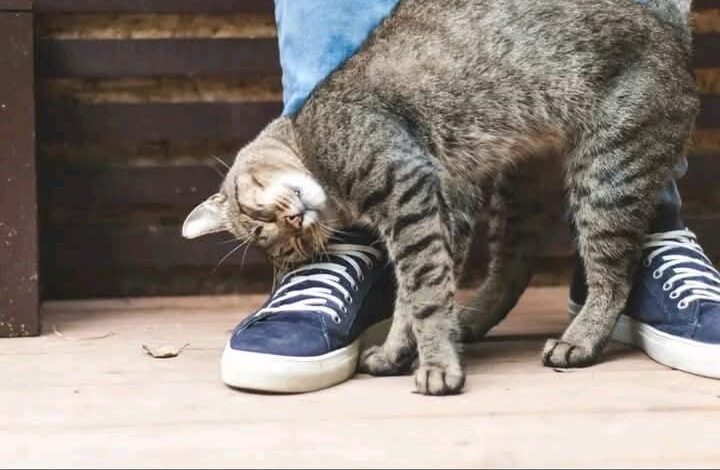
In the quiet choreography of a shared life with a feline companion, few gestures are as ubiquitous or as evocative as the “rub.” You walk through the door after a long day, and almost as if summoned by the turn of a key, your cat appears. They weave a serpentine path around your ankles, pressing their forehead into your palm or sliding their cheek along your shin with a rhythmic, motorized purr. To the casual observer, it is a simple request for attention or perhaps a subtle hint that the food bowl is nearing empty. However, beneath the surface of this soft, furry encounter lies a sophisticated language of biology, sociology, and profound emotional depth. When a cat rubs against you, they are participating in an ancient ritual of claiming, bonding, and love.1
To truly understand this behavior, one must first appreciate that cats inhabit a sensory world dominated by scent. While humans rely primarily on sight and sound to navigate their surroundings, a cat’s reality is constructed from a complex map of olfactory markers. They possess specialized scent glands located on their cheeks, chin, the top of their forehead, their paws, and the base of their tail.2 When a cat engages in what behaviorists call “bunting”—the act of pressing their head against an object or person—or “allorubbing”—the sliding of their body along another—they are essentially “ink-stamping” you with their unique pheromonal signature.3+1
This act of scent-marking is, at its core, a way of claiming you. By depositing these pheromones, your cat is effectively declaring that you are safe, familiar, and part of their territory.4 To your cat, the world is divided into two categories: the known and the unknown. Anything that does not carry the communal scent of the “pride” is a potential threat. By rubbing against you, they are ensuring that you smell like home. Because these pheromones fade over time, cats feel a biological imperative to perform “emotional maintenance,” reapplying their scent daily to reaffirm that you still belong to them. It is a quiet, persistent adoption process that never truly ends.
Beyond the biological mechanics of scent, the rub serves as a sophisticated social greeting.5 In the wild, members of a feline colony will rub against one another after a period of separation to exchange information and re-establish their social hierarchy.6 When your cat rushes to meet you at the door, winding through your legs with a high, quivering tail, they are performing a heartfelt welcome. They are not merely acknowledging your presence; they are expressing a genuine relief and happiness at your return. Even the most reserved or shy cats will reserve this specific physical greeting for the individuals they trust most, making it one of the highest compliments a human can receive from a feline.+1
Furthermore, the act of rubbing is a powerful tool for self-regulation. Much like a human might seek out a hug or a familiar comfort object to decompress, a cat uses physical contact to reinforce their own sense of security.7 The pressure of leaning into you and the exchange of warmth triggers the release of calming chemicals in the feline brain.8 It is a mutually beneficial interaction; the cat isn’t just seeking to soothe you, they are using your presence to soothe themselves. This is why you will often notice a cat rubbing against you during moments of transition—such as when you first wake up or when the household becomes particularly noisy—as they seek to ground themselves in the familiarity of your bond.+1
In a household with multiple cats, this behavior takes on an even more vital role in maintaining the peace. “Allorubbing” between cats helps to create a “group scent,” a collective olfactory identity that helps prevent conflict and fosters a sense of communal belonging.9 When your cat extends this behavior to you, they are explicitly including you in their social group. To them, you are not merely a caretaker or a source of sustenance; you are a central member of the family unit. You are a “super-cat” of sorts, and by sharing their scent with you, they are inviting you into the safety of the inner circle.
The nuance of the rub can also vary depending on which part of the body the cat uses. A head-butt, or “bunting,” is often considered an act of extreme trust, as the cat is placing their face and eyes in a vulnerable position near you. A side-rub, where they lean their entire weight against your leg, is a sign of deep affection and a desire for physical closeness. Even the tail-wrap—that moment when a cat curls the tip of their tail around your arm or leg as they pass—is a tactile “handshake” that signals a strong emotional connection.10
Of course, cats are also masters of manipulation, and they are well aware that rubbing against a human is an effective way to get what they want. Whether it is a nudge for a treat, a request to open a door, or a plea for a scratch behind the ears, they use their physical presence to direct our attention. However, even these “transactional” rubs are built on a foundation of trust. A cat will not use physical proximity to ask for food from someone they fear or distrust.
In a modern world that often feels fast-paced, noisy, and disconnected, the gentle nudge of a cat offers a rare and steady anchor. It is a reminder that communication does not always require words, and that the most profound bonds are often built in quiet, repetitive moments of contact. When your cat weaves through your legs or presses their forehead against yours, they are offering you a window into their heart. They are saying that in a world full of strangers and unknown scents, you are their sanctuary. You are safe, you are valued, and you are claimed.
The next time you feel that soft pressure against your leg, take a moment to pause. Do not just see it as a habit or a request. Recognize it for what it truly is: a radical act of trust. Your cat is choosing you, adopting you, and loving you, one soft nudge at a time. It is a reminder that while we may think we own our cats, the reality is far more poetic—they have claimed us as their own, and we are all the better for it.